

Introduction: Understanding Ivory and Its Legacy
Learn the history of ivory, how to identify real vs. fake ivory, and understand current UK ivory laws. A must-read guide for collectors and conservation advocates.
Ivory has long held a place of prestige across cultures for its striking beauty, durability, and symbolic value. From ancient ivory carvings to ornate antique ivory artifacts, this rare material has been celebrated in global art, decoration, and craftsmanship. Valued for centuries in religious, ceremonial, and luxury objects, elephant ivory and other forms of tusk-derived ivory became deeply embedded in cultural heritage.
However, behind its gleaming surface lies a complex and often troubling history. The demand for ivory fueled decades of exploitation and illegal poaching, contributing to the rapid decline of endangered species like elephants, walruses, and narwhals. As international awareness grew, so did the introduction of strict ivory trade bans and global conservation efforts, including enforcement through CITES regulations and national legislation.
This comprehensive guide explores the history of ivory, how to identify genuine ivory vs. imitations, and the latest developments in ivory trade laws, including the UK Ivory Act and its global counterparts. Whether you’re a seasoned antique ivory collector, a vintage art enthusiast, or a conservation advocate, this article will help you better understand one of the world’s most controversial and culturally significant materials.
What is Ivory?
Ivory is a hard, creamy-white material primarily obtained from the tusks and teeth of certain animals, most notably elephants, but also from walruses, narwhals, hippopotamuses, warthogs, and sperm whales. This natural substance is composed almost entirely of dentine, a dense, bone-like tissue found beneath the enamel of teeth. When cut and polished, ivory reveals a smooth, lustrous surface that has made it highly prized for centuries in sculpture, jewelry, religious artifacts, and decorative antiques.
Due to its fine texture and aesthetic appeal, ivory has been widely used in both functional objects and artistic works across cultures. However, the global demand for elephant ivory and other forms of animal ivory has fueled illegal poaching, leading to the dramatic decline of several endangered species. Today, the use and trade of ivory are tightly regulated under international laws and conservation agreements aimed at protecting vulnerable wildlife.
Cultural and Historical Uses of Ivory
Ivory has been treasured and used in art and daily objects for millennia, particularly in decorative arts. Its versatility and aesthetic appeal have made it a popular material across cultures and eras:
For millennia, ivory has been cherished across civilizations for its beauty, rarity, and remarkable versatility. From ancient times through the Victorian era, ivory was a preferred material for both functional objects and fine art, thanks to its smooth texture, light color, and ease of carving. The cultural importance of ivory artifacts, especially those made from elephant and whale ivory, is deeply embedded in global history.
Here are some of the most notable historical and cultural uses of ivory:
🪵 Sailors’ Scrimshaw
During long 18th and 19th-century whaling voyages, sailors used whale ivory to pass the time by carving intricate maritime scenes onto discarded tusks and teeth. These carvings, known as scrimshaw, often depicted whaling ships, ocean life, and personal memories. Once considered folk art, scrimshaw is now highly collectible and valued for its authenticity and historic charm.
🧧 Chinese Ivory Carvings
Chinese artisans are renowned for their exceptional skill in ivory carving, a tradition dating back thousands of years. Delicately detailed pieces such as snuff bottles, netsuke, fans, and clothing toggles were both decorative and symbolic. Master carvers often created elaborate miniatures of dragons, ships, temples, and village scenes, making Chinese ivory artworks some of the most sought-after in the world.
✝️ Religious Artifacts
Ivory has played a central role in religious iconography. From medieval crucifixes to Buddhist statues and ceremonial implements, ivory’s purity and workability made it a favored material in the creation of sacred objects across Christianity, Hinduism, Buddhism, and other traditions.
🎹 Victorian-Era Luxury and Everyday Objects
During the 19th century, ivory became synonymous with status and sophistication. In the Victorian era, it was used extensively in the production of piano keys, jewelry, cutlery, handheld fans, brushes, and other refined personal items. These antique ivory objects reflect both the aesthetic preferences and the industrial scale of ivory use during this period.
📦 Everyday Decorative and Functional Items
Beyond high art and religious use, ivory was also crafted into practical and decorative items for everyday life. These included furniture inlays, card cases, books, snuff boxes, and hair accessories, demonstrating the broad demand for ivory across all social classes.
The widespread historical use of ivory across continents and centuries underscores its cultural importance and the scale of its consumption. In particular, the 19th century marked a peak in the demand for elephant ivory, embedding it into countless household items, luxury goods, and art collections—many of which remain in circulation today as collectible antiques.

Ivory Look-Alikes and Synthetic Alternatives
Because of ivory’s high value and strict trade regulations, many look-alike materials have been used to imitate its appearance. Accurately identifying genuine ivory versus synthetic or organic alternatives is essential for collectors, appraisers, and conservation professionals. Here are the most common materials that resemble ivory—and how to tell them apart:
🦴 Bone
Often mistaken for ivory, bone can be identified by the presence of tiny black or dark brown pits, which are remnants of former blood vessels. Unlike ivory’s smooth surface and fine grain, bone typically has a more porous, speckled appearance when examined closely.
🧪 Celluloid & Bakelite (Early Plastics)
These vintage plastics were commonly used in the late 19th and early 20th centuries to imitate ivory. Celluloid tends to yellow with age, while Bakelite often darkens and emits a distinctive odor when warmed. Both materials lack the natural Schreger lines or cross-hatching patterns unique to elephant ivory.
🌰 Vegetable Ivory (Tagua Nut)
This sustainable, eco-friendly alternative comes from the tagua palm nut and closely mimics the color and texture of elephant ivory. While it carves well and polishes smoothly, vegetable ivory typically appears in smaller sizes and lacks the fine internal grain of true ivory.
🧼 Resin and Modern Plastics
Today’s synthetic ivory replicas are often made from resins or plastic composites. These materials tend to be uniform in texture, overly smooth, and usually show no natural grain or irregularities. Under magnification or UV light, they also behave differently compared to real ivory.
Being able to distinguish these ivory alternatives is critical not only for accurate identification but also for complying with modern ivory trade regulations. In the next section, we’ll explore more detailed identification techniques used by collectors and experts.

How to Care for Ivory Safely
Ivory is an organic material that reacts to changes in temperature, humidity, light, and handling. Older pieces, especially those that have been carved, scrimshawed, or mounted in metal, can become fragile over time. Proper care is essential to prevent cracking, warping, or permanent surface damage.
1. Control Temperature and Humidity
Ivory expands and contracts with the environment, so stable conditions are crucial.
- Ideal humidity: 45%–60%
- Ideal temperature: 15–20°C (59–68°F)
- Avoid sudden changes — ivory can crack within hours if moved from a cold room to a hot, dry one.
- Never place ivory near radiators, open fires, direct sunlight, or heating vents.
A stable environment is the single most important factor in preserving ivory.
2. Avoid Direct Sunlight and Strong Light
Light causes yellowing, fading of pigment, and drying of the surface.
- Display ivory in shaded areas.
- Use UV-filtered glass if displaying in cabinets.
- Avoid spotlights and LED lamps positioned close to the object.
3. Handle Ivory as Little as Possible
The natural oils and acids from human skin can stain or degrade ivory.
- Always handle pieces with clean cotton gloves.
- Support the item from its base — do not hold thin or carved sections.
- Avoid touching scrimshawed or ink-filled surfaces.
4. Cleaning Ivory Safely
Ivory should be cleaned only when necessary, and always gently.
Do NOT:
- Soak ivory in water
- Use soaps, bleach, detergents, or solvents
- Scrub with abrasive pads or metal tools
If cleaning is required:
- Use a soft, dry brush or microfiber cloth to remove loose dust.
- For stubborn grime, lightly dampen a cotton swab with distilled water only, then dry immediately.
- For valuable, coloured, scrimshaw, or cracked ivory, contact a professional conservator.
5. Prevent Cracking and Warping
Look for early warning signs:
- Fine hairline cracks
- Warping or separation from mounts
- Unusual yellowing
- Fading or bleeding of pigments (e.g., scrimshaw ink)
If any of these appear, stop handling the piece and store it in a stable environment. Consult a professional conservator for advice.
6. Storage and Display
- Store ivory in closed cabinets away from heat sources.
- Use mounted supports for heavy or irregularly shaped carvings.
- Wrap small items in acid-free tissue for long-term storage.
- Never seal ivory in plastic bags — this traps moisture and promotes mould.
7. Restoring or Repairing Ivory
Ivory should never be glued, filled, bleached, sanded, or polished by a non-expert.
Improper restoration can permanently devalue the item and cause further cracking.
If you suspect an item needs repair:
- Photograph it
- Record environmental conditions
- Consult a recognised antique ivory conservator or restoration specialist
8. Document Your Ivory Items
Proper documentation is useful for:
- Insurance
- Conservation history
- Legal compliance with the Ivory Act
- Future valuation
Record:
- Photographs from all angles
- Measurements and weight
- Visible cracks or areas of deterioration
- Provenance and age
- Any conservation treatments performed
Why Ivory Needs Special Care
Ivory is hygroscopic — it absorbs and releases moisture. This makes it more like wood or bone than stone or metal. Because of this, improper storage can cause rapid deterioration. Many historic museum pieces show severe cracking simply due to past environmental neglect.
If you own ivory, caring for it responsibly helps preserve cultural and historical artefacts without contributing to modern demand.
Changes in UK Ivory Trade Laws: From Past Legality to Strict Bans
Trading in ivory was once legal in the UK under certain conditions. Specifically, it was permissible to sell ivory items that predated 1947 without restriction. However, in April 2018, the UK government announced sweeping changes, introducing a near-total ban on ivory sales with only a few exceptions.
The Former Rules on Selling Ivory
Before the new legislation, the trade in antique ivory was relatively unrestricted, provided the item was made before 1947. Exceptions were granted for items that contained less than 10% ivory, such as musical instruments, furniture, and pianos with ivory inlays. Additionally, objects of significant historical or artistic value, as determined by museum and heritage experts, were also exempt from restrictions.
The Shift: The UK Ivory Act 2018
The UK Ivory Act 2018, which came into force in June 2022, dramatically altered the landscape of ivory sales. The new law prohibited the sale of almost all ivory items, even antiques, with limited exceptions, including:
- Items containing less than 10% ivory by volume, made before 3 March 1947 (such as pianos or furniture).
- Pre-1918 items of outstanding artistic, cultural, or historical importance, which must undergo expert assessment and registration.
The law also introduced strict rules requiring sellers to register items meeting exemption criteria and obtain an exemption certificate. Items that failed to meet these standards, such as silver cutlery with ivory handles, would have to be stripped of their ivory components or sold as scrap without their ivory parts.
The Expansion of the Ban in 2023
In 2023, the ban was further extended to include ivory from other species beyond elephants, such as:
- Walruses
- Narwhals
- Hippopotamuses
- Sperm whales
This expansion also explicitly prohibited the sale of scrimshaw pieces—whale ivory carvings traditionally made by sailors.
The End of Easy Sales: The Law Has Changed
While it was once legal and commonplace to sell antique ivory without regulation, those days are over. The UK now has some of the strictest ivory laws in the world. Sellers can no longer monetize ivory items unless they meet very specific exemptions, which must be proven through registration and assessment. Simply owning ivory, however, remains legal, and there are no laws prohibiting collectors from keeping their existing pieces.
Severe Penalties for Breaking the Law
Under the new laws, selling non-exempt ivory without registration can result in heavy fines and even imprisonment. The UK government’s stricter stance reflects a global push to protect endangered species and combat poaching.
In summary: What was once an open market for antiques is now tightly controlled. Ivory that was easy to sell before must now meet strict conditions, and the sale of ivory from other species, including scrimshaw, is banned entirely. These laws represent a fundamental shift from a once-tolerated trade to a near-total prohibition, emphasizing conservation and the protection of endangered species.
For comprehensive and up-to-date information on the UK’s regulations regarding ivory, please refer to the official government resources below:
- Guidance on Dealing in Items Containing Ivory: This page provides detailed instructions on the legal requirements for buying, selling, or hiring items made of or containing ivory in the UK. GOV.UK
- Ivory Act 2018: The full text of the legislation outlining the prohibition on dealing in ivory and the specific exemptions allowed under the law. Legislation.gov.uk
These resources offer essential guidance for anyone involved in the trade or ownership of ivory items, ensuring compliance with current UK laws.
1. Selling Ivory: Ignorance is Not an Automatic Defence
Under the UK Ivory Act 2018, it is an offence to “deal” (which includes selling, offering to sell, or arranging a sale) in prohibited ivory if you:
knew or suspected, or ought to have known or suspected, that it was ivory, or was made of or had ivory in it. (As per Section 12 of the Act and reiterated in government guidance).
This phrasing means that:
- Actual Knowledge (“knew or suspected”) is an offence.
- Constructive Knowledge (“ought to have known or suspected”) is also an offence.
In practice, for a commercial seller (such as an antique dealer, auctioneer, or even a repeat seller), the law holds you to a higher standard of due diligence. You ought to know how to identify a common antique material like ivory (using the methods detailed in the article) or confirm that your item meets one of the narrow exemptions and has been properly registered.
A court or enforcement body will consider the seller’s position. For a professional dealer, claiming simple ignorance that a piece of bone-like material was ivory is unlikely to be a successful defence.
2. Buying Ivory: Responsibility is Shared
The Act prohibits buying ivory as part of the general ban on “dealing” (Section 1).
- The government guidance specifically states: “If you’re buying or hiring an item… you must check it’s registered or certified as exempt before you take ownership of it.”
This puts a direct onus on the buyer to confirm the legality of the item. If you buy an item without checking its registration, and it turns out to be prohibited ivory, you have participated in the illegal “dealing” of the item. Claiming you didn’t know it was ivory is equally risky for a buyer as it is for a seller.
Conclusion: The Safest Rule
Your advice is sound and reflects the stringent nature of the UK ban:
If you are unsure, the best course of action is to leave the item there or seek expert, legally compliant advice before proceeding with any purchase or sale.
The law is designed to eliminate the market for illegal ivory by removing the “I didn’t know” excuse, especially from those who should reasonably be expected to know better.
Note: Currently, mammoth ivory remains legal to trade, as it comes from an extinct species and is not covered under the UK Ivory Act. However, due to its similarity to elephant ivory, buyers and sellers should exercise caution and ensure proper identification.
A Note on International Regulations
While this article provides comprehensive information regarding the UK, readers dealing with ivory outside the UK must be aware that other jurisdictions have different, often complex, regulatory systems.
The UK’s law represents a near-total ban with extremely narrow, registered exemptions. In contrast, the US and EU systems rely on different historical cut-off dates and complex definitions:
- 🇺🇸 United States (Federal Law): The commercial sale of African elephant ivory across state lines is generally prohibited, with a key exemption for “ESA Antiques.” To qualify as an antique, an item must be 100 years or older and meet strict criteria regarding its importation and lack of modification after 1973. Additionally, individual US states (like New York and California) have enacted their own, even stricter, total bans.
- 🇪🇺 European Union: Commercial activity in “worked” ivory items made before March 3, 1947 may be permitted within EU member states, but generally requires an official Article 10 CITES certificate for sale. The import and export of elephant ivory from the EU is almost entirely banned, save for very narrow exceptions (e.g., items for museums or pre-1975 musical instruments used by performing artists).
Always consult the relevant national and state/regional laws before buying, selling, or transporting any item containing ivory.
How To Get An Exception Certificate In Order To Sell Ivory In The Uk

How to Identify Real Ivory from Imitations
Identifying genuine ivory—particularly elephant ivory—requires close observation and an understanding of its distinct characteristics. As laws surrounding the sale of ivory have tightened globally, the ability to distinguish authentic ivory from bone, plastic, or synthetic alternatives is more important than ever for collectors, appraisers, and conservation advocates.
🔍 Basic Identification Techniques
Important Note: Some traditional identification tests — such as the hot pin test, burning smell, or scraping — can permanently damage genuine ivory or create false positives. These methods should be avoided on valuable antiques. Non-destructive inspections (visual analysis, magnification, Schreger lines, UV light, and professional appraisal) are safer and more reliable.
👁️ Visual Inspection
- Ivory: Look for fine cross-hatching patterns known as Schreger lines, especially visible on cut ends. These intersecting lines form angles that help distinguish elephant ivory (angle >115°) from mammoth ivory (angle <90°).
- Bone: Displays small black or brown pits, which are remnants of blood vessels. Bone also tends to be more porous and uneven than ivory.
🔥 The Heat Pin Test
- Ivory: Pressing a hot pin against real ivory will leave no visible mark and produces only a faint scent.
- Plastic/Resin: Will melt or deform and emit a strong chemical odor, often immediately giving away its artificial composition.
💡 UV Light Test
- Ivory: Glows a subtle blue-white under ultraviolet (black) light.
- Plastic/Celluloid: Typically glows dull white or yellow, and lacks the subtle iridescence of real ivory.
🧪 How to Distinguish Ivory from Plastic and Celluloid
While basic tests can rule out obvious fakes, early plastics like celluloid and Bakelite were designed to closely mimic ivory. The following advanced tests help distinguish these materials with greater accuracy.
1. Texture and Surface Comparison
- Ivory: Feels dense, cold, and smooth to the touch, with subtle natural grain irregularities and a soft organic sheen.
- Plastic/Celluloid: Feels lighter and warmer. Molded plastics may show seam lines from factory molds—something never seen in carved ivory.
2. The Smell Test (Performed During the Heat Test)
- Ivory: When gently heated, emits a light, organic odor similar to burning hair or fingernails—due to its organic dentine structure.
- Plastic/Celluloid: Produces a sharp, chemical or burnt plastic smell, which is strong and unpleasant.
3. The Pin Test (Complementary to Heat Test)
- Celluloid: Melts quickly and releases an acrid smell.
- Bakelite: May char rather than melt, but still emits a distinctive chemical odor.
- Ivory: Remains unchanged if the pin is pressed lightly.

4. Weight and Sound Test
- Ivory: Feels heavier for its size and produces a soft, bell-like sound when gently tapped against another piece of ivory.
- Plastic: Generally lighter, and when tapped, sounds hollow or muted.
5. Magnification Test
- Ivory: Under 10x magnification, reveals natural grain lines (Schreger lines or subtle linear patterns), which are always irregular and non-repetitive.
- Plastic/Resin: Attempts to mimic grain may appear too uniform or patterned. These repeating textures are a telltale sign of synthetic production.
✅ Key Identification Summary
| Test Type | Ivory | Plastic/Celluloid | Bone |
|---|---|---|---|
| Visual | Schreger lines (cross-hatch) | No grain or uniform patterns | Black pits (blood vessels) |
| Heat/Pin | No melt, faint organic smell | Melts quickly, strong chemical odor | May burn, but no melting |
| UV Light | Blue-white glow | Yellow or dull white glow | Varies, may fluoresce slightly |
| Weight/Sound | Heavy, soft “click” | Light, hollow sound | Moderate weight |
| Magnification | Irregular grain | Repetitive synthetic grain | Porous texture, visible pits |
Pro Tip: Ivory is always smooth and clean-looking, and the grain varies depending on the cut—but it never has visible blood vessels or seams, unlike bone and plastic. The combination of tests—not just one—should always be used to determine authenticity, especially when legal sale or conservation concerns are involved.

Ivory does not have veins and therefore lacks the blood vessel marks found in bone. Instead, you should look for cross-hatching patterns—known as Schreger lines—depending on how the ivory is cut or its grain orientation. Ivory is always very smooth and clean in appearance compared to bone, which is the most reliable way to tell them apart.
| Feature | Ivory | Bone | Plastic | Resin |
|---|---|---|---|---|
| Schreger lines | ✓ | ✗ | ✗ | ✗ |
| Blood vessel pits | ✗ | ✓ | ✗ | ✗ |
| UV glow | Blue-white | Varies | Yellow/dull | Dull |
| Smell when heated | Organic | Burnt | Chemical | Chemical |
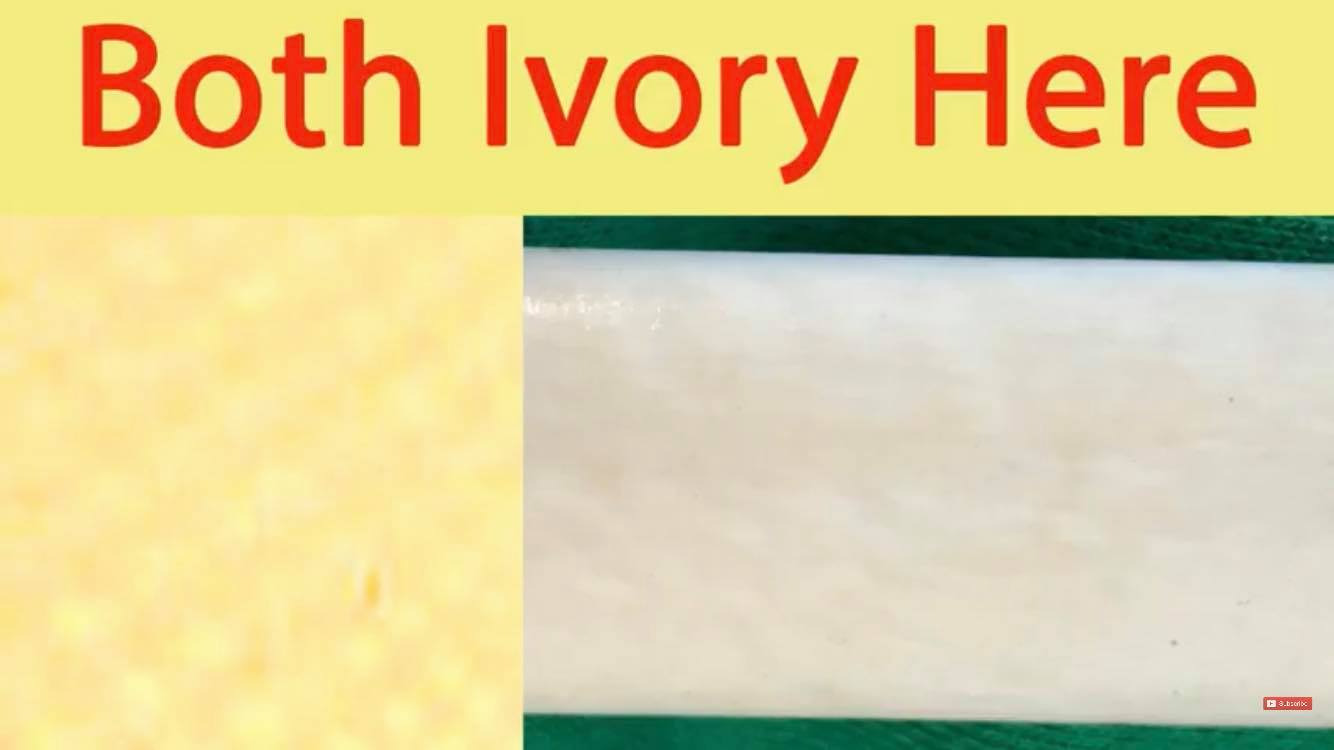
🎥 Watch My Full Identification Tutorial on YouTube:

Conservation and Ethical Considerations
The global ivory trade has been a major driver behind the decline of elephant populations and other ivory-bearing species, pushing several to the edge of extinction. In response, conservation efforts have intensified over recent decades, leading to widespread legislation, trade bans, and public awareness campaigns. Today, responsible ownership, ethical decision-making, and education play vital roles in protecting the future of endangered wildlife.
🌿 How to Support Ethical Practices and Conservation
🔄 Promote Sustainable Alternatives
Choose eco-conscious materials like vegetable ivory from tagua nuts. This natural, renewable substitute closely resembles ivory in texture and appearance—offering an ethical solution that supports artisan craftsmanship without harming wildlife.
🌍 Support Conservation Initiatives
Contribute to and engage with reputable conservation organizations such as the World Wildlife Fund (WWF) and the Born Free Foundation, which work to combat illegal poaching, protect endangered species, and restore natural habitats.
📢 Advocate for Stronger Protections
Encourage the enforcement and strengthening of international frameworks like CITES (the Convention on International Trade in Endangered Species of Wild Fauna and Flora). These regulations govern the legal trade of endangered species and help standardize protections across borders.
🎓 Educate Others
Raise awareness about the ecological impact of ivory consumption. Sharing knowledge about ethical collecting, modern ivory laws, and sustainable alternatives helps reduce demand and informs future generations about the consequences of illegal wildlife exploitation.
💬 Personal Perspective: Balancing Heritage and Conservation
While the priority must always be to protect endangered species and support sustainable alternatives, there is also value in preserving historical ivory artifacts. Many antique ivory pieces represent significant cultural heritage and were created during times when ivory use was widespread and socially accepted. These objects, already long separated from the animals that produced them, serve as reminders of history and craftsmanship that can coexist with modern conservation values.
Conservation is a shared responsibility. By making informed, ethical choices—and supporting policies and practices that protect vulnerable species—we contribute to a more sustainable and respectful future for both cultural heritage and the natural world.
📘 Conclusion
This comprehensive guide has explored the history of ivory, its diverse cultural uses, and detailed methods for identifying genuine ivory from imitations. It has also provided up-to-date insights into the evolving ivory trade laws, particularly in the UK, and highlighted the importance of ethical collecting practices.
As global awareness grows and legislation continues to tighten, every collector, seller, or enthusiast must act responsibly. By valuing transparency, education, and conservation, we can honor the past while helping to protect the future of endangered species and the ecosystems they depend on.
Bookmark our site and subscribe to our blog for more in-depth articles on antiques, collectibles, and conservation practices.
If you like this article, then you will love some of these.
Frequently Asked Questions About Ivory
1. Is it legal to sell antique ivory in the UK or US?
In the UK, it is illegal to sell most ivory items under the Ivory Act 2018, with limited exemptions for registered items—such as pre-1947 objects containing less than 10% ivory, or pre-1918 items of outstanding cultural value. All must be officially registered or certified.
In the US, federal laws prohibit interstate sales of ivory, with some narrow exceptions (e.g., documented pre-1976 antiques). State laws vary, with California, New York, and New Jersey banning most ivory sales entirely.
2. What is mammoth ivory, and is it legal?
Mammoth ivory comes from extinct woolly mammoths and is not covered by most ivory bans, including the UK Ivory Act. It remains legal to buy and sell, but because it closely resembles elephant ivory, it must be clearly identified and documented to avoid legal confusion or seizure.
3. How do Schreger lines help identify ivory?
Schreger lines are unique cross-hatch patterns seen in elephant and mammoth ivory when viewed in cross-section.
- Elephant ivory: Schreger lines intersect at angles greater than 115°.
- Mammoth ivory: Angles are typically less than 90°.
These patterns are key in distinguishing real ivory from fakes or from other tusked species.
4. Can I bring ivory when traveling internationally?
In most cases, you cannot legally travel with ivory, especially across international borders.
- Items not covered by exemptions (e.g., musical instruments with documentation) may be seized at customs.
- The Convention on International Trade in Endangered Species (CITES) prohibits commercial ivory movement across borders without permits.
Even personal or inherited items can be flagged, so it’s best to avoid traveling with ivory entirely.
5. What are ethical alternatives to elephant ivory?
Modern, cruelty-free alternatives include:
- Vegetable ivory (from the tagua nut)
- Bone or antler (from naturally shed or ethically sourced animals)
- Resins and composites designed to mimic ivory texture
These alternatives offer a sustainable way to enjoy the look of ivory without harming endangered wildlife.
6. Can I give ivory away as a gift?
In the UK, gifting ivory is legal, provided there is no money exchanged and the transfer is not commercial. However, if the ivory item is later sold, the same legal restrictions and registration requirements apply.
7. Can I inherit ivory?
Yes. Inheriting ivory is legal in both the UK and most countries. The ownership can pass between generations, but you still cannot sell or trade the item unless it meets exemption criteria and is properly registered.
8. Can I own ivory, or do I have to destroy it?
You are allowed to own ivory legally in the UK, US, and most countries. There is no requirement to surrender, destroy, or dispose of ivory already in your possession. However, resale is strictly regulated.
9. Can I insure ivory?
Yes, but insuring ivory has become more complex due to legal restrictions. Many insurers now require:
- Proof of provenance and date (pre-1918 or pre-1947)
- Current registration or exemption status
- Independent valuation from a certified expert
If your ivory item is stolen, damaged, or destroyed, the payout value is usually determined based on historic value, replacement cost, or auction comparables—not resale potential, since most ivory can no longer be sold legally.
✅ Tip for Collectors:
Even if you can’t legally sell ivory, well-documented items still hold historic, cultural, and insurable value. Keep all provenance paperwork and seek expert registration or appraisal when possible.
Love the Hunt? Don’t Leave Empty-Handed
If you enjoy discovering the stories, value, and hidden gems behind antiques and collectibles, there’s plenty more waiting for you. Explore deeper, learn smarter, and level up your treasure-hunting game with these useful links and resources:
🔗 Useful Links & Resources
📺 YouTube — weekly hunts, hauls, valuations & tips:
https://www.youtube.com/@AntiquesArena
📚 Our Published Books for Resellers — written and published by us, these guides are designed to help you buy smarter, sell confidently, and understand the antiques trade from the inside:
https://antiquesarena.com/books/
🌍 My Website — articles, guides & more:
https://www.antiquesarena.com
🔗 All My Links in One Place:
https://linktr.ee/antiquesarena
💬 Facebook Community:
https://www.facebook.com/AntiquesArena/
🐦 X (Twitter):
https://twitter.com/antiquesarena
🎧 Patreon — behind-the-scenes content & support:
https://www.patreon.com/AntiquesArena
🌐 Need Solid Website Hosting?
For anyone running a blog, store, or online reselling business, I personally use and highly recommend WPX.
They offer:
• Fast, reliable hosting that grows with your needs
• Expert 24/7 support at no extra cost
• Built-in email hosting
If you’d like to support my work at no cost to you, please consider using my referral link (I receive a small commission):
👉 https://wpx.net/?affid=9610
☕ Support the Channel
If you’d like to buy me a coffee and help keep the content flowing:
https://paypal.me/AntiquesArena


